
The Precision Edge in Optical Manufacturing
Modern optical systems depend on components machined to tolerances measured in microns. From laser communication terminals to medical endoscopes, the performance of the final assembly relies on the accuracy of every turned surface. According to a recent market analysis, global demand for precision machining continues to climb as industries adopt tighter optical specifications. custom precision optical cnc turning has become the backbone of this supply chain, enabling manufacturers to produce complex geometries in metals, plastics, and composites with repeatable sub-micron precision. XTJ CNC, with over 20 years of ISO 9001-certified experience and a fleet of 120+ advanced machines, routinely delivers parts to ±0.003 mm tolerances while supporting industries from automotive to aerospace. The ten applications that follow represent the most impactful uses of this technology today.
- 📞 Phone: +1 218 527 7419
Optics and Photonics
1. Precision Lens Mounts and Barrels
Lens barrels must hold optical elements in exact alignment while accommodating thermal expansion. CNC turning produces these components from aluminum, brass, or stainless steel with threaded interiors that mate perfectly with standard optical tubes. The repeatability of CNC turning ensures that every barrel in a production run matches the master dimensions within microns, critical for zoom assemblies and multi-element objectives.
2. Laser Diode Housings
High-power laser diodes generate significant heat that must be managed to maintain wavelength stability. Turned copper or aluminum housings act as heat sinks while preserving the precise mechanical interface needed for beam collimation. Custom features such as mounting flanges, fiber-optic alignment grooves, and hermetic sealing surfaces are all produced in a single setup.
3. Prism and Mirror Cells
Optical instruments rely on kinematically mounted prisms and mirrors that resist shifting under vibration or temperature change. Custom-turned cells provide registration features, spring-loaded retention, and adjustment threads that keep optics stable. Materials range from lightweight magnesium for airborne systems to corrosion-resistant bronze for marine environments.
Medical and Life Sciences
4. Endoscope Optical Trains
Minimally invasive surgery depends on rigid endoscopes with precisely spaced lens stacks. CNC turning produces the thin-walled tubes and spacer rings that maintain optical alignment along the instrument's length. The tight concentricity achievable with CNC turning — often below 0.005 mm — directly affects image quality and depth of field in the final scope.
5. Surgical Microscope Components
Zoom mechanisms, objective housings, and beam-splitter bodies require concentricity within a few microns. Turned parts from titanium or medical-grade stainless steel meet both optical and biocompatibility requirements. The ability to produce complex internal profiles, such as light-baffle threads and dovetail interfaces, makes CNC turning the preferred method for these critical subassemblies.
6. Diagnostic Sensor Housings
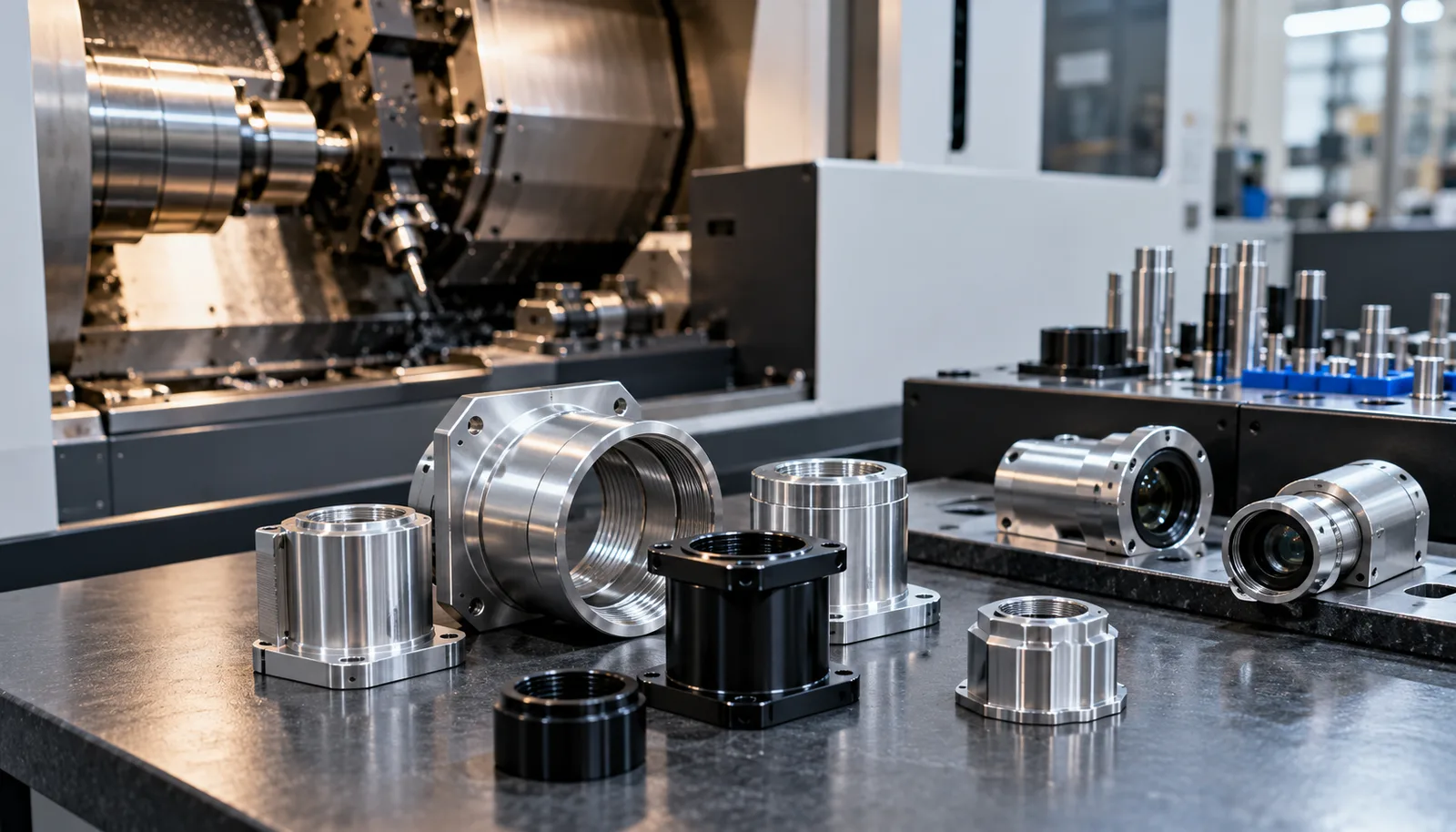
Spectrometers, blood-analysis optics, and fluorescence detectors use custom-turned cells that shield sensitive detectors from stray light while providing accurate positioning for filters and dichroic mirrors. Many of these housings incorporate thin-wall sections to reduce weight without sacrificing rigidity, a geometry that only precision turning can achieve efficiently.
Aerospace and Defense
7. Satellite Optical Bench Components
Spaceborne telescopes and earth-observation instruments use lightweight turned structures from aluminum or titanium. Every gram counts, and CNC turning can produce thin-walled, ribbed structures that maintain stiffness while minimizing mass. The dimensional stability of these turned components directly influences the resolution and pointing accuracy of the payload over years in orbit.
8. Targeting and Surveillance Optomechanics
Military optics must survive shock, vibration, and temperature extremes. Custom-turned housings for infrared lenses, laser rangefinders, and night-vision assemblies are machined from materials chosen for dimensional stability — such as Invar for low thermal expansion or hardened steel for wear resistance. The ability to hold tight tolerances across production batches is essential for system interchangeability in the field.
Automotive and Industrial
9. LiDAR Sensor Housings for Autonomous Vehicles
LiDAR systems require rotating mirrors or scanning mechanisms with ultra-low runout. Precision-turned bearing housings and rotor components ensure consistent beam steering at thousands of revolutions per minute. The combination of tight concentricity and surface finish achievable with CNC turning directly impacts the sensor's range and angular resolution.
10. Encoder Components for Precision Motion Control
Optical encoders rely on accurately spaced grating disks and mounting hubs. Turned aluminum or glass-reinforced plastic parts provide the rotational accuracy needed for servo feedback in robotic arms, CNC machine tools, and coordinate-measuring machines. The hub's concentricity and the disk's perpendicularity to the axis of rotation are both established during the turning operation.
Meeting the Challenge of Custom Optical CNC Turning
As industries push for higher resolution, smaller form factors, and lower costs, the role of custom precision optical CNC turning will only grow. The ten applications above represent only a fraction of what is possible when experienced machinists, modern multi-axis equipment, and rigorous quality systems come together. Partnering with a manufacturer that holds both ISO 9001 and IATF 16949 certifications, operates over 120 advanced CNC machines, and has over 20 years of experience ensures that your optical components meet the most demanding specifications. Whether you need a single prototype in five days or a low-volume production run with no minimum order quantity, the capabilities of precision CNC turning continue to redefine what is achievable in optical system design.