
A beer filtration system removes suspended particles, yeast cells, and haze-forming colloids from beer after fermentation, producing a bright, stable, and visually appealing product. Commercial breweries rely on these systems to meet quality standards, extend shelf life, and achieve consistent clarity batch after batch.
How Beer Filtration Works
Beer filtration typically involves one or more stages of mechanical separation. The two main approaches are depth filtration and membrane filtration.
Depth Filtration
Depth filters trap particles within a porous medium such as diatomaceous earth, filter pads, or wound polypropylene cartridges. Beer passes through the medium, and solids are retained throughout the matrix. Depth filtration is economical and handles high solids loads, making it a common choice for primary or rough filtration in large-volume breweries.
Membrane Filtration
Membrane filters use a thin film with precisely controlled pore sizes to separate particles at the surface. Pleated cartridges made from polypropylene, polyethersulfone, or nylon provide absolute retention ratings down to submicron levels. Membrane filtration delivers sharper cutoffs and is often used for polishing or final filtration. The Brewers Association provides technical resources on membrane applications in craft brewing.
Crossflow vs. Dead-End
In dead-end filtration, all beer flows through the filter medium, and retained solids build up on the surface. In crossflow filtration, beer recirculates across the membrane surface, sweeping away accumulated solids and extending filter life. Crossflow systems are common for high-value beers where yield and consistency are critical.
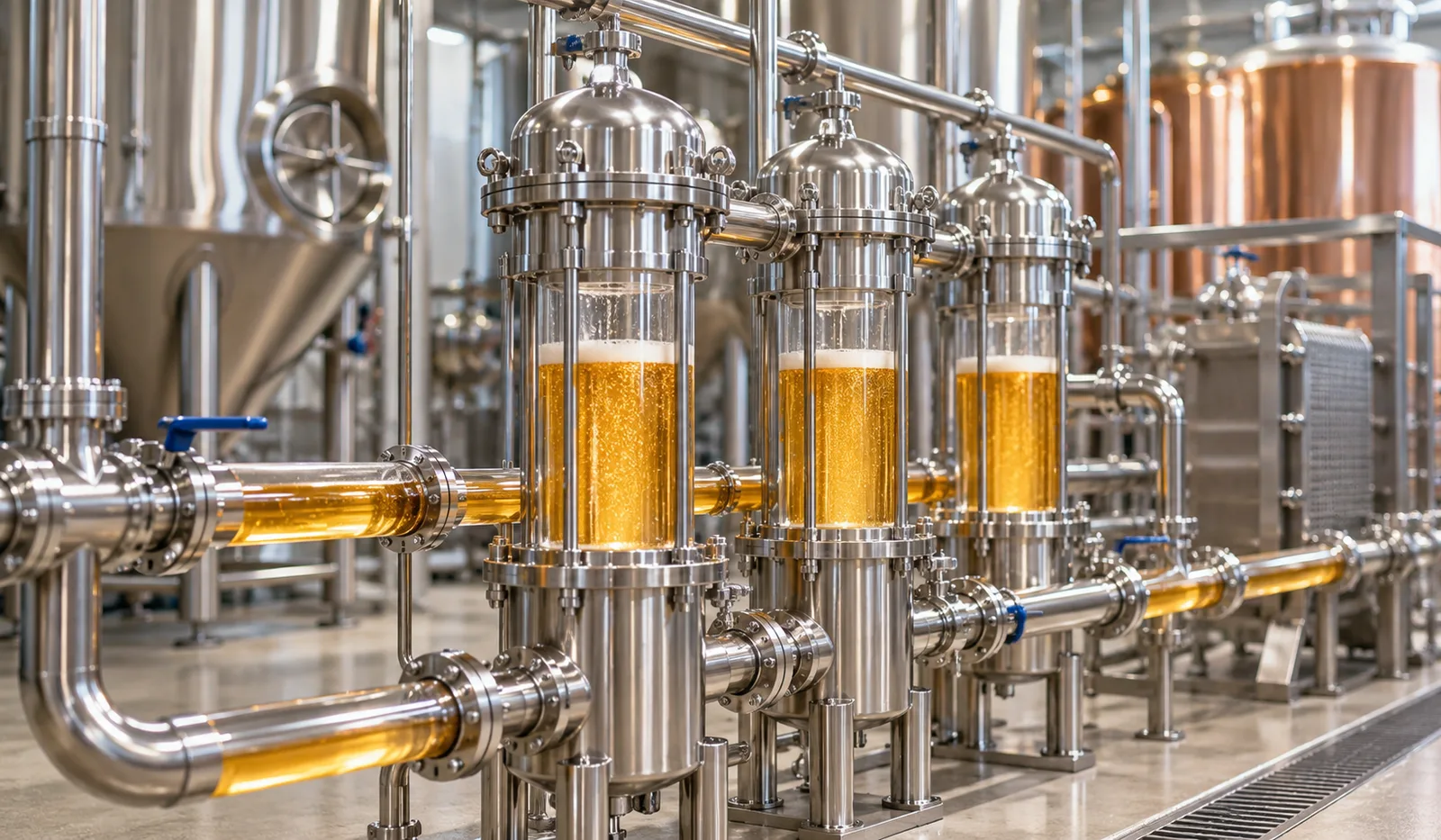
Why Beer Filtration Matters for Commercial Breweries
Clarity is the most visible quality indicator for beer drinkers. A well-designed beer filtration system removes yeast, chill haze, and microbial contaminants without stripping desirable flavor compounds. The result is a shelf-stable product that looks and tastes the same from the first pint to the last. According to the Master Brewers Association of the Americas, consistent filtration practices are a cornerstone of quality assurance in commercial brewing.
Top 10 Beer Filtration Systems for Commercial Breweries
The market offers a range of filtration technologies suited to different brewery sizes, beer styles, and production volumes. Here are ten widely adopted systems:
- Pleated cartridge filters – High surface area pleated cartridges (PP, PES, PTFE, nylon) deliver consistent micron ratings and are available in standard 10-, 20-, and 40-inch lengths. They are a workhorse for polishing and final filtration.
- Membrane cartridge filters – Absolute-rated membrane cartridges provide retention down to 0.1 µm or finer, ideal for cold sterilization and bright beer production.
- Depth filter cartridges – Wound or melt-blown polypropylene cartridges offer graded density for high dirt-holding capacity at lower cost, suitable for pre-filtration.
- Diatomaceous earth filters – DE filters use fossilized diatom skeletons as a filter aid and excel at high-flow rough filtration in larger breweries.
- Sheet filters (pad and frame) – Cellulose-based filter sheets in plate-and-frame housings provide a traditional method for fine filtration still widely used in craft and specialty brewing.
- Crossflow membrane systems – Recirculating crossflow designs reduce fouling and maintain high flux rates, making them suitable for continuous or semi-continuous operation.
- Bag filters – Felt or woven polypropylene bags capture coarse solids and serve as low-cost pre-filters ahead of finer stages.
- Stainless steel filter housings – Multi-round housings with quick-open closures allow fast cartridge changeouts and are built for clean-in-place sanitation.
- High flow filter systems – Large-format cartridges (40-inch and longer) with high flow rates minimize the number of housings needed, reducing capital cost and footprint.
- Automated self-cleaning filters – Backwashable or scraper-type filters reduce manual intervention and are gaining traction in large-scale continuous brewing operations.
Each system has trade-offs in capital cost, operating expense, throughput, and beer quality. The right choice depends on the brewery's volume, beer styles, and quality targets.
Common Questions About Beer Filtration Systems
What micron rating do I need for commercial beer?
Typical targets are rough filtration at 10–50 µm, polishing at 1–5 µm, and final or sterile filtration at 0.2–0.5 µm. Many breweries use a two-stage approach with a coarse pre-filter followed by a finer polishing filter to balance throughput and clarity.
Does filtration strip flavor from beer?
Any filtration step can remove some flavor-active compounds, but modern membrane and pleated cartridges can be selected to minimize stripping. The goal is to remove haze and microorganisms while preserving the intended flavor profile.
How often should filter cartridges be replaced?
Change frequency depends on beer turbidity, flow rate, and cartridge type. Typical intervals range from several hundred to several thousand hectoliters per cartridge set. Monitoring differential pressure is the best indicator for replacement timing.
Can a beer filtration system handle different beer styles?
Yes, with proper cartridge selection. Lagers and light beers typically require tighter filtration, while many ales and hazy IPAs use looser filtration or none at all. A flexible system with interchangeable cartridges accommodates style changes.
What is the difference between a beer filtration system and a beer filter?
The terms are often used interchangeably, but a beer filtration system generally refers to the complete assembly of housing, cartridges, valves, piping, and controls, while a beer filter may refer to the cartridge or media alone. For procurement, specifying the full system ensures compatibility.
Choosing the Right Filtration Partner
Commercial breweries need a filtration provider that understands both brewing science and industrial scale. Pullner Filter, a global filtration manufacturer with facilities in Dubai, Shanghai, and Miami, supplies pleated, membrane, depth, and high-flow cartridges to breweries worldwide. Their ISO 9001-certified factory produces over 4,000 filter elements per day with membrane testing down to 3 nm. For breweries looking to upgrade or install a new beer filtration system, Pullner offers free samples, engineering support, and custom design services.